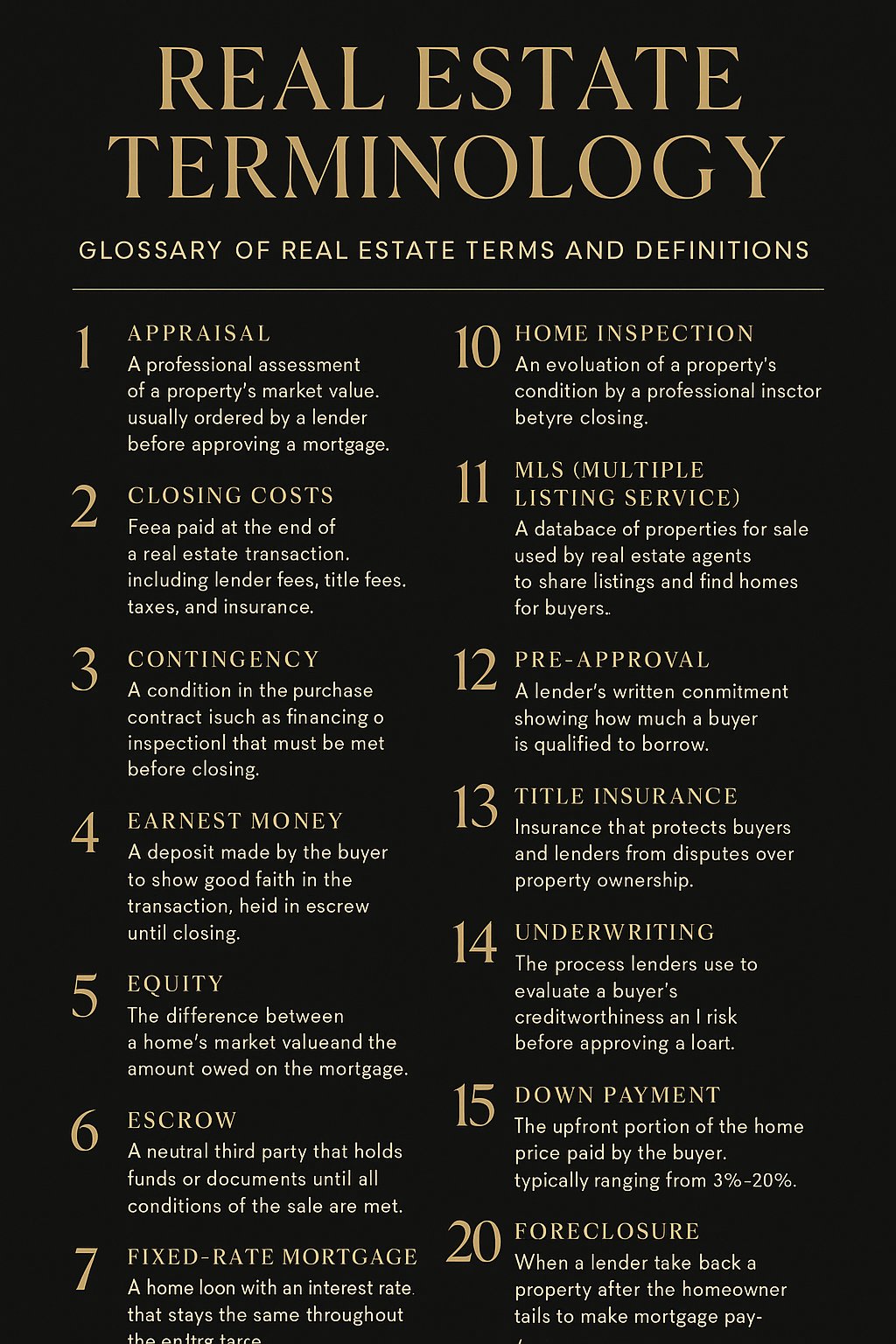
Understanding real estate terminology is one of the most important parts of buying or selling a home. From contracts and contingencies to escrow and equity, the industry is filled with real estate agent terms, realty terms definitions, and other common real estate terms that can feel overwhelming if you’re new to the process.
That’s why I created this glossary of real estate terms and definitions—to give my clients a clear and easy way to understand the language of real estate.
Why Knowing Real Estate Terms Is Important
As a local real estate agent, I know that buying or selling a home is one of the biggest financial decisions you’ll ever make. Having a strong understanding of basic real estate terms empowers you to:
-
Ask better questions during showings, offers, and negotiations
-
Feel more confident when signing paperwork
-
Understand the financial impact of things like interest rates, down payments, and equity
-
Avoid misunderstandings that could delay or derail a closing
My goal as your agent is not just to guide you through the process, but also to educate you along the way. This glossary will walk you through the most common real estate terms you’ll hear, with easy-to-understand definitions so you can feel prepared at every step.
Top 20 Real Estate Terms to Know
1. Appraisal
A professional assessment of a property’s market value, usually ordered by a lender before approving a mortgage. An appraisal ensures the home’s price is fair and protects the lender from financing more than the property is worth.
2. Closing Costs
The fees and expenses you pay at the end of a real estate transaction. These can include lender fees, title search fees, recording fees, appraisal costs, transfer taxes, and homeowner’s insurance. Buyers and sellers often split these costs, depending on local custom or contract negotiation.
3. Contingency
A condition in the purchase contract that must be met before closing. Common contingencies include securing financing, passing a home inspection, or selling your current home. Contingencies protect both buyers and sellers by ensuring certain terms are satisfied before the deal is finalized.
4. Earnest Money
A “good faith” deposit made by the buyer when submitting an offer. This money is held in escrow and applied toward the purchase price at closing. If the buyer backs out without a valid contingency, the seller may keep this deposit.
5. Equity
The difference between your home’s current market value and the amount you still owe on your mortgage. For example, if your home is worth $500,000 and you owe $300,000, your equity is $200,000. Equity builds wealth and can be used later through refinancing or selling.
6. Escrow
A neutral third party that holds money and documents until all conditions of the sale are met. Escrow ensures that funds (like earnest money or down payment) and legal documents are only released once both sides fulfill their contractual obligations.
7. Fixed-Rate Mortgage
A home loan with an interest rate that stays the same throughout the entire loan term (usually 15, 20, or 30 years). Fixed-rate mortgages offer stability and predictable monthly payments.
8. Adjustable-Rate Mortgage (ARM)
A home loan with an interest rate that can change over time. It usually starts with a lower fixed rate for a set period (e.g., 5 years) before adjusting annually based on a financial index. ARMs can save money early on but carry future payment risk.
9. Home Inspection
A professional evaluation of a property’s condition, typically performed before closing. Inspectors check the roof, foundation, plumbing, electrical, HVAC systems, and more. The results help buyers negotiate repairs or price adjustments before finalizing the purchase.
10. MLS (Multiple Listing Service)
A database where real estate agents share property listings. The MLS is the most reliable and up-to-date source of homes for sale, giving buyers access to properties that may not appear on public search sites right away.
11. Pre-Approval
A lender’s written statement showing how much you’re qualified to borrow after reviewing your income, assets, debts, and credit score. Pre-approval strengthens your offer by showing sellers you’re financially ready to buy.
12. Title Insurance
An insurance policy that protects buyers and lenders against legal claims or disputes over property ownership. Title insurance ensures you have clear ownership rights after purchase.
13. Underwriting
The behind-the-scenes process lenders use to evaluate your loan application. Underwriters verify income, assets, employment, credit history, and the appraisal before issuing final mortgage approval.
14. Down Payment
The upfront cash a buyer pays toward the home’s purchase price, typically 3%–20%. The higher your down payment, the smaller your mortgage and monthly payment will be.
15. Foreclosure
A legal process where a lender takes back a home after the homeowner stops making mortgage payments. Foreclosed homes are often resold, sometimes at a discount, but can require repairs or additional paperwork.
16. HOA (Homeowners Association)
A governing body that manages and enforces rules within a residential community or condominium. Homeowners pay monthly or annual dues to cover services like landscaping, snow removal, and shared amenities.
17. Comparative Market Analysis (CMA)
A report prepared by a real estate agent comparing recently sold homes in the area to estimate a property’s market value. A CMA helps sellers set a competitive list price and helps buyers make strong offers.
18. Listing Agreement
A legally binding contract between a homeowner and a real estate agent that authorizes the agent to market and sell the property. It outlines commission terms, contract length, and agent responsibilities.
19. Offer
A written proposal from a buyer to purchase a property. It specifies the purchase price, contingencies, closing date, and other terms. Sellers can accept, reject, or counter the offer.
20. Closing
The final step in the home buying or selling process. At closing, all funds are transferred, documents are signed, and ownership of the property officially passes from seller to buyer.
Final Thoughts
Learning the definition of real estate terms makes the buying or selling process smoother, less stressful, and far more empowering. By understanding this real estate terminology glossary, you’ll be better prepared to make confident decisions, avoid surprises, and move through your transaction with ease.
As a Wilmette real estate agent, I’m here to guide my clients every step of the way—from breaking down real estate terms definitions, to negotiating offers, to handing over the keys. If you’re ready to buy or sell a home in Wilmette or Chicago’s North Shore, I’d love to be your trusted guide.